The Terminal Man
by Andrew G. Watters, Esq.
I don't think people realize this, but I have an avocation as a systems integrator with experience developing Advanced Information Systems in the LAMP stack, both internally and for occasional outside clients. Unfortunately, or fortunately (depending on how you look at it), virtually all my business stems from the law firm instead of the I.T. consulting. I get it, but the issue for me is that the I.T. consulting is fulfilling to the technical side of my brain and I also get to help people. Take a look at my Linux/macOS tips page for some solid gold. But I.T. is far less profitable because nobody thinks billable hours are appropriate for an I.T. consultant unless they are packaged as part of a flat fee for hardware systems. I digress.
We started planning the current iteration of the next-generation law firm portal in 2024 (I had been working on a new web-based portal for a year or two, but I decided to go in the X11 direction instead). The problem with the current portal is not that it works-- it does-- the problem is that it is a clumsy, hacked, "spaghetti code" effort that has been ongoing for 9 years and never finished. That concept ended when we hired Jeremy, our in-house software engineer. Suddenly, the firm was able to seek and obtain code on request for anything. Initially, I went a little overboard by asking Jeremy to work on random projects that have nothing to do with law. But then I got real and asked him to develop the next-generation law firm portal, which will run on a heavy duty server as a X11 application for all our employees. The reason for X11 is that it is included natively on all the Macs in the office. Our current standard workstation is a Mac Mini with an Apple Studio Display, except for me-- I have a heavy duty custom Linux workstation with dual 8K screens. X11 allows us to run one application across both platforms while centralizing compute and documents on the server that runs the application. This is great for compliance purposes, and the side benefit is that everyone logs in via SSH with X11 forwarding, which is highly secure. The performance is instantaneous at the office, although we still have more work to do in order to have the application perform properly when a user is remote.
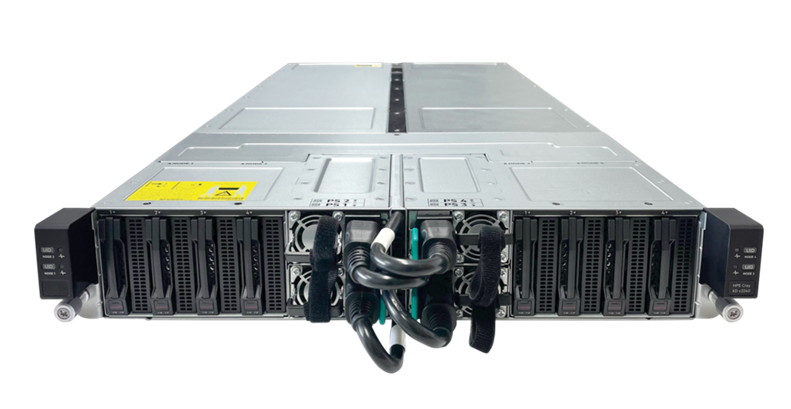
Because I'm extreme, I decided to go with a solution that I found randomly while looking up the successor to Cray-- the world's first manufacturer of supercomputers. Cray is now a Hewlett Packard Enterprise company, and they have some great products. I took a look at the HPE Cray XD2000, and it seemed ideal for my use case. Among other reasons, you can have up to four nodes in one chassis-- though we will have two: one node with a workstation GPU, and the other node with a data center GPU for A.I. inference. The price is very reasonable for what you get-- not a huge step above my current workstation, which costs as much as a luxury car. Plus I'm getting HPE service and support. So the configuration I settled on with the sales guys was this. It has one node with a Nvidia L40S and the other node with a Nvidia H100. The node with the L40S is just for me as my workstation, and the node with the H100 will be the law firm portal server. This may seem like overkill, but considering that the price for each node is less than the cost of my existing workstation while providing a lot more, it starts to make sense. I also like the compact configuration because I'm running out of space in my rack and need to make sure the cooling works for this.
OK, so why do we need all of this firepower? Well, I'm happy to reveal/announce that we are working on a couple of A.I. inference subsystems that will help us with law practice. For example, there is the A.I. chatbot that we intend to have, which will take questions in plain English and give back summaries of cases, key dates that are coming up, and other important information that is currently distributed across many pages on the law firm portal. But the GPU will also come in handy for several non-law R&D projects that I've been working on, such as Infinity Stone and The Tower. In other words, this is a dual-purpose, all-in-one system that is intended to consolidate several disparate systems and make things more efficient for us. When you consider that this is going to replace several servers that otherwise would have to be purchased, it starts to make perfect sense.
The goal here is multi-fold. First, I want to have a new and improved professional workstation for my intensive work that maintains the excellent dual 8K screen capability that I have had since 2023 when I got the Nvidia A6000 on special order for my current setup. The L40S accomplishes that goal and this time, I can put the computer in my I.T. closet since I can wire the wall outlet for active HDMI. This will make my office quieter than it is now. Second, I wanted to be able to use my existing workstation as the computer for the Trial Laboratory, which requires realtime quad-4K video capture using a special capture card that I have. Third, I want to save space and consolidate the processing and compute in one system. Finally, I want to drastically increase document security and convenience by having the server node process all documents and eliminate the tedious steps of downloading from the portal, editing locally, and uploading to the portal, which is what we currently do. With inline TeX editing and compilation, plus our own XMPP chat, and integrated email, the user will never need to leave the portal screen to do their work. That was a key goal, and we are set to accomplish all of this with the HPE Cray setup.
Why am I doing all this? Well, I enjoy the challenge of creative problem solving. But I also want to demonstrate what is possible with no restrictions or restricted workflows and see what the optimal solution is that emerges. Here, the only time we will ever need to leave the portal is to use Microsoft Word, which happens when an opposing attorney sends Word documents to us. All other functions and document creation will be done with TeX on the portal, similar to how Overleaf has an online TeX editing system. But this system will be free to use/prepaid. Thus, I can sell packaged systems like mine with the best-ever law firm portal system built-in. Now you see my cards. I'm also doing this as a proof of concept before marketing the system to other law firms. I'm a businessman, though the Terminal Man reference is kind of an in-joke because the Michael Crichton novel is apropos to my life, for reasons not germane to this article. So is The Lawnmower Man, haha.
Essentially, the next-generation portal will realize my vision of a Linux-based workflow that is platform-independent on the user side and runs entirely free and/or open source software. We could even use Microsoft Windows to run the portal if we really wanted to slum it, which would defeat the purpose of spending ridiculous amounts on the firm's collection of Mac hardware. In any case, this is the realization of years of wanting this system to be done.
I have this running joke on JD Underground (programmed by yours truly) that I am "the greatest lawyer-programmer in the world." Well, it actually looks to be true, folks, though I'm (a little bit) sorry for being immodest. We'll update this when the system is actually running, and hold on to your hats because it's going to be out of this world.
