The Rogue Mariner
by Andrew G. Watters, Esq.
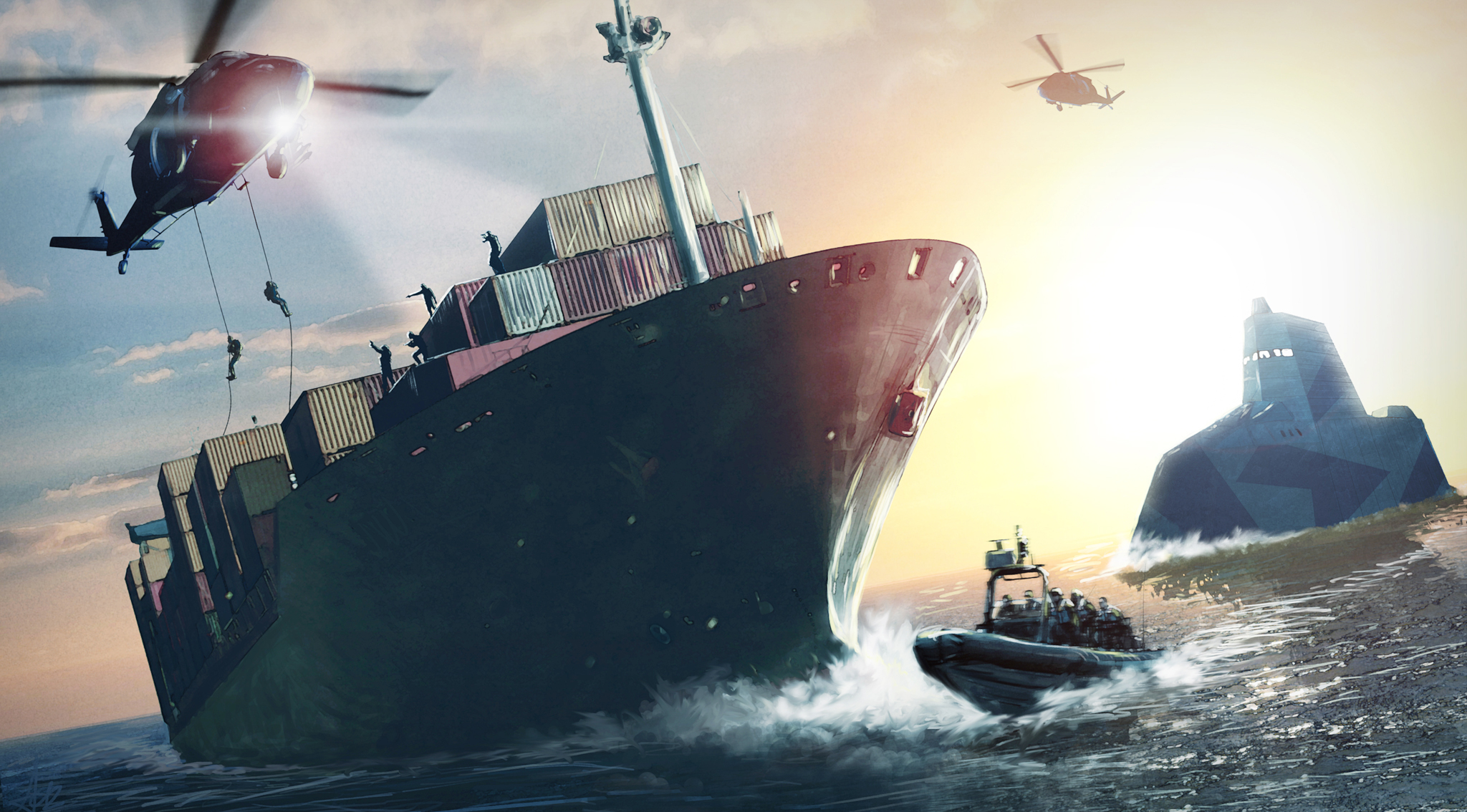
In 2013, responding to the problem of piracy in the Horn of Africa, I proposed a privateer vessel called the Rogue Mariner, as described in the attached concept plan. The principles behind the design of the vessel are equally applicable to the problem of drug cartel activity in the Western Hemisphere. Senator Mike Lee has recently introduced a bill that would allow the President to grant letters of marque against the drug cartels, essentially using profit motive to combat cartel activity in the Caribbean. I commend this effort as one of the few ways left to effectively fight the war on drugs without direct government involvement. It got me thinking again about the Rogue Mariner, and I decided to write up the proposal as an article here. I've been told this is solid gold; I've been told it's crazy. Maybe the truth is somewhere in between.
ROGUE MARINER

A privately operated maritime security vessel with
next-generation capabilities.


Concept Plan


October 18, 2013
v. 1.4

Rællic Systems
director@raellic.om


EXECUTIVE SUMMARY

The annual cost of piracy in the Horn of Africa region alone is in the billions of dollars, mostly in the form of higher fuel consumption ($3.3 billion) from increased speeds and re-routing of traffic, as well as private security ($1.1 billion) and military operations ($1.2 billion).  Ransoms ($0.16 billion) are a small fraction of the total.

Multinational task forces, while certainly the most powerful weapon against piracy, are slow to respond, must prioritize missions based on a variety of concerns, are not likely to last indefinitely despite making a significant difference, and involve significant political and other barriers to actually accomplishing the desired result of reducing the cost of piracy.

The purpose of the proposed vessel is to provide an unprecedented worldwide response capability with a strong, multi-mission platform from which to conduct a wide range of maritime operations.  These would include counter-piracy and general security, hostage rescue, shipping escorts, and humanitarian relief.  Each of these missions is legal for private mariners to perform, so long as they follow the laws of the flag state and international law.

Clients would include, in order of precedence, shipping lines, insurance companies, governments with specialized needs, and private individuals.  Though charters would not be possible, a range of valuable services unique to client requirements and resources would be offered, with the only limit being the availability of the ship and the minimum prices needed to make the program possible.

In the event the primary missions became uneconomical, the ship could be leased or sold to an allied navy and reconfigured as a light destroyer or patrol vessel, or converted into the world’s fastest and most powerful superyacht for a billionaire who has everything else.

The ideal business model is based on a series of fees associated with various service options, ranging from straightforward patrols and searches at lower prices to specialty packages such as complex hostage rescues against large targets, or even interim power and water supply needs in disaster-struck areas.

The program is possible in today’s legal environment and is possible or within reach of current commercially available technology.  The ship requires no classified or restricted information or products, although there would be significant challenges associated with obtaining the best propulsion system if its manufacturer is not willing to work with an international client.

The estimated cost for the ship and all necessary equipment is $400-800 million, depending on configuration, with an intended service life of twenty-five years.

Personnel and operating costs are undetermined and would depend on mission-specific configurations, but are substantial.  With an estimated average complement of one hundred crew earning an average of $100,000 per year, plus forty highly qualified security force members earning an average of $250,000 per year, a base personnel cost of $20 million per year for compensation seems reasonable.  Combined with the amortized cost of the ship, the floor of income needed to make the program possible is estimated to be $36-$52 million per year, or $3 million to $4.3 million per month.  Mission-specific crew packages would be available, but the need for a consistent pool of qualified members suggests that a relatively constant level of staffing would be required.  In any event, to make the venture economical before considering profit or additional expenses such as repairs, selection and training, upgrades, and other needs, the program would need to reliably capture at least $3-$4.3 million per month in service fees from clients.  This is miniscule compared to the cost of piracy and security, and it appears there is ample room in the industry for the services that would be offered.

The ship fills a need that slots above what is possible with even the most capable private vessel, but below the more expensive option of an official navy ship.  The goal is a privately operated program that offers a number of the capabilities of the new Zumwalt class of U.S. Navy destroyers at a fraction of the cost, plus a level of speed and overall performance that exceeds what is possible from the U.S. Navy’s Littoral Combat Ships.  This degree of value is possible because the proposed vessel does not require the weapons systems, stealth, advanced communications, signals intelligence, or Anti-Submarine Warfare capabilities of U.S. Navy ships.

PROPOSED SPECIFICATIONS

Type: 		Multi-mission private maritime security vessel,
		with an emphasis on versatility and modularity for
		a variety of client needs and expectations.

Displacement: 	5,000 tons

Length:		130 meters (426 feet)

Beam:		25 meters (80 feet)

Draft:		8 meters (26 feet)

Power and
Propulsion:	Pressurized water reactor producing at least
		100 MW (130,000 hp) of electric power, or
		equivalent steam turbine performance

		or

		Any combination of gas turbines in a 100 MW
		configuration.

Speed:		60-70 knots

Range:		Unlimited (nuclear)
		8,000 nmi or more (conventional)

Endurance:	Unlimited with resupply (nuclear)
		30 days or more without resupply (conventional)

Complement:	100 crew
		40 security forces members

Aircraft:	Two UH-60 Blackhawk helicopters, and up to two
		smaller helicopters plus UAVs.

Boats:		A minimum of one large rigid-hulled inflatable
		boat, two speedboats, and assorted underwater and
		robotic craft depending on mission requirements.

Sensors:	Commercially available radar, 3-D sonar, signals
		measurement and collection equipment, and other
		unrestricted tactical instruments.

Armament:	Variable output, variable wavelength shipborne
		laser with megawatt-class continuous beam, plus
		non-lethal directed energy weapons.  Small arms up
		to .50 BMG, plus whatever can be obtained under a
		U.S. Class III or destructive device license from
		the Bureau of Alcohol, Tobacco, and Firearms.
		Configuration permitting the addition of
		some amount of client’s own weapons systems and
		munitions if compatible.

Facilities:	Large deck accommodating multiple aircraft.
		Internal amphibious hangar and covert launching
		area for boats, submersibles, and robots.
		Desalinization plant.  Recreation areas.

GENERAL DESIGN

The provided concept art and dimensions are based on a scaled-down version of the U.S.S. Zumwalt, which is currently under construction.  The actual ship would be significantly different for a number of reasons.

First, the futuristic hull design of the Zumwalt is reportedly unstable, and the main reason for it is its low-observable characteristics in deflecting airborne radar.  Here, the ship should have a hull design that permits high speed operation and maximum stability at those speeds, which are key to its mission.  The hull can be as traditional as necessary because there is no foreseeable need for low-observable traits.  Clients who have a need to evade airborne radar during a black operation or some other covert mission have needs that are beyond the scope of this program.  The hulls of the current U.S. Littoral Combat Ships are an appropriate starting point because they already have high speed capability and are a competing product.

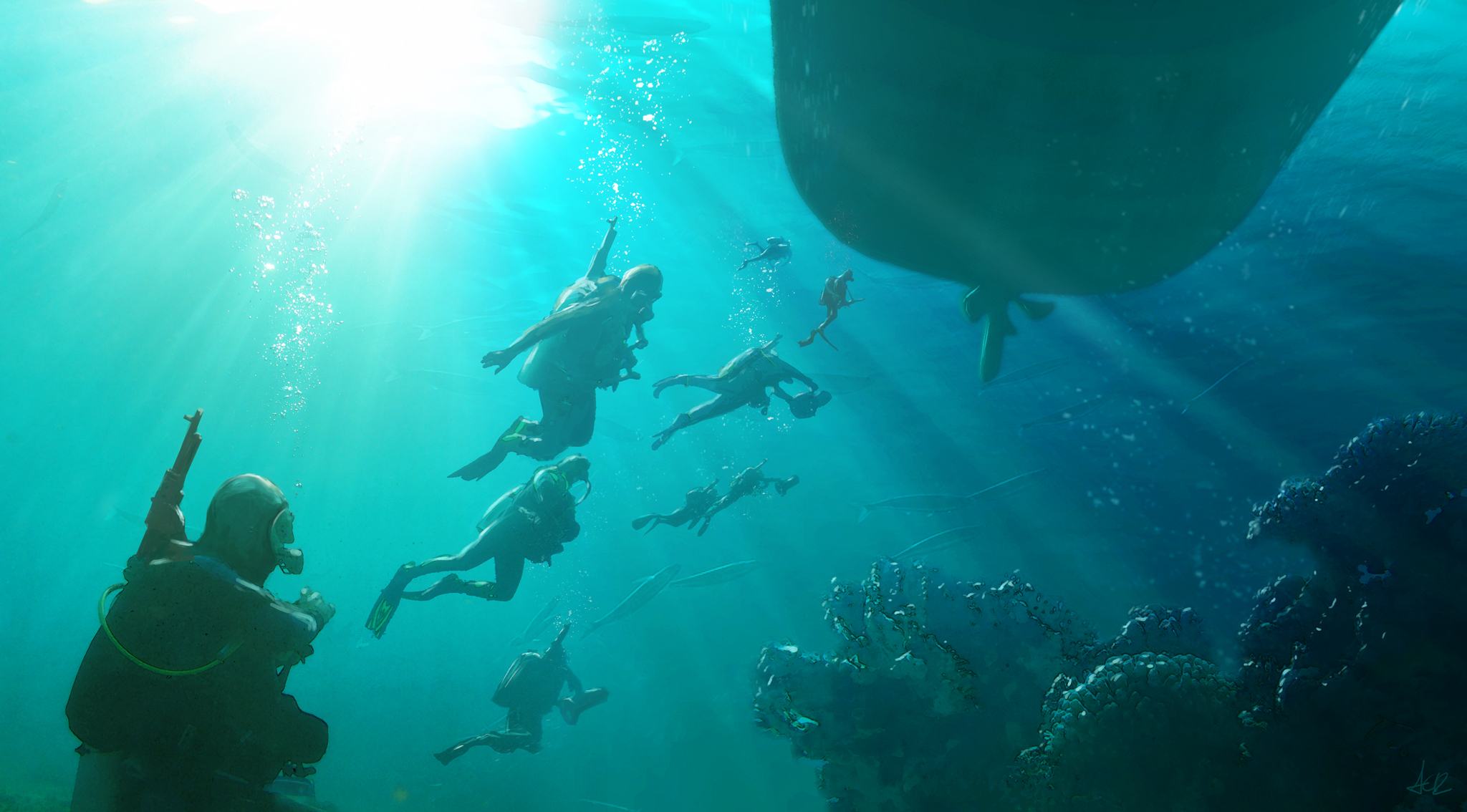
Second, the design here needs to accommodate an internal amphibious hangar large enough to carry, launch, and recover a large rigid hulled inflatable boat, two power boats, swimmers, and a selection of underwater and robotic vehicles, as well as a client’s own equipment.  Though not required to be as large as what is found on ships such as the U.S.S. Ponce, the internal bay will necessitate the raising of the flight deck above what is depicted in the concept art.

Third, without artillery or other large weapons systems, there is no need for a magazine and this space may be used for other purposes.  While the design should consider the possibility that the ship may be sold or leased for operation as a naval vessel, it is unlikely that it would or could be turned into a full-fledged warship.  Examples of uses of the space a magazine would occupy are additional berths, recreation facilities, supercomputers, or general use modular space for client needs.

Fourth, the design must provide the option of using either nuclear or conventional power, based on whether nuclear propulsion will be possible.

Finally, the design must include appropriate berthing arrangements for a variety of personnel and guests.  An ideal option is a reasonable but not excessive VIP section with a small number of berths for owners, investors, and high-paying guests, and the remainder of the berths configured to accept different numbers of crew and security forces depending on mission requirements.

POWER AND PROPULSION

The best possible choice is a naval nuclear propulsion system with at least a 90% level of Uranium enrichment, which lasts for the full twenty-five year service life of the ship without refueling.  A naval reactor has many benefits including unlimited range, use of one system for both thermal and electric needs, no moving parts, a constant supply of reliable, safe power irrespective of actual load, proven designs, and a deep pool of qualified talent to operate the many subsystems that would be required.  Nuclear power would also enable the onboard supply of Jet-A to be smaller and used only for aviation needs, and these needs could be resupplied while underway by a civilian-operated oiler, or by the helicopters themselves if within range of a facility with fuel sales available and configured with extra tanks.  Smaller fuel bunkers would increase the top speed of the ship significantly and permit additional dry storage.

In addition to these advantages, a reactor would supply the instant, explosive power on demand that would enable the new capabilities and missions contemplated in this plan.  For example, constant high speed of 60-70 knots would permit a trip halfway around the world in an unheard of seven to nine days.

On top of extreme speed, a reactor would provide a shipborne laser with a continuous beam limited in power only by future technology.  Presently, a beam of several megawatts is possible based on systems already in operation, and a target of ten megawatts seems likely by the time the ship would actually be built.  Such a device could melt weapons, boil seawater, bore through hulls, dazzle or disable sensors from extreme ranges, defend against aerial attacks, and detonate incoming ordnance.  Under gas turbine power, these options would not be available without spooling up the turbines high enough to guarantee output, which would significantly increase fuel consumption.  A reactor could also supply backup power and towing services to an actual navy ship for as long as necessary with no penalty.  This additional power supply would enable new humanitarian missions and unlimited desalinization.

Unfortunately, the nuclear systems likely to be available for the foreseeable future that can accomplish the desired goals are classified U.S. designs with specialty fuel.  However, there is significant interest in the nuclear industry in marine propulsion, and at this time it is not clear that the desired system is not possible.

A selection of reactors is available in other countries as well, and it may be possible to obtain them under license or other arrangements.  For example, the Rosatom reactors currently used on nuclear icebreakers in the Arctic provide the right amount of power and have at least 90% enrichment.  Future Rosatom reactors currently in development will have a twenty-five year life before refueling, and may not require the special fuel/waste handling that is presently necessary.  However, the systems may be restricted to domestic Russian use or otherwise unavailable.  Unless these systems or recently obsolete U.S. systems with sufficient enrichment levels can be obtained, it may not make sense to use a reactor when various gas turbine configurations are available.

The licensing process for operating a reactor in the U.S. other than one used solely for research or education also may be a challenge.  All commercial reactors in the U.S. are subject to initial and annual licensing and oversight by the Nuclear Regulatory Commission, and the fees associated with this are in the multiple millions annually.  Although it may be possible to flag a nuclear-powered ship in a less regulated nation, this would prevent the program from being covered under the industry-funded insurance program administered by the NRC, which provides up to $12.6 billion of coverage for nuclear incidents after private insurance is exhausted, plus potential additional coverage borne by the U.S. Government.

An older reactor design that requires refueling at the ten year mark or less, such as the current Rosatom systems, appears very likely to be possible.  However, this would require a second ship to be constructed so that it became available at the ten year mark for the crew to occupy.  This actually seems possible due to the cost savings from using an older reactor design, and there may be enough income to justify this approach.  Given the length of a potentially year-long refueling overhaul as well as the gap in coverage and income from not conducting operations, it would be important to make a decision at the five year mark on whether to attempt a second vessel.  This should be ample time to assess industry needs, and there is the backup option of reconfiguring a nuclear vessel with gas turbines or vice versa if proper design planning is made so different power packs are available.

The safe approach would be starting with a gas turbine ship to test industry needs, and upgrading to nuclear propulsion after several years when new reactor designs are more available and financial performance is assured.  Basically, it is not possible at this time to determine whether the ship would have nuclear or conventional propulsion, and so both options should be considered.

PERSONNEL

Without the right personnel, the ship would merely be a floating hulk.  The most important work of the program would be the properly conducted selection of qualified applicants.  It is suggested that compensation be significantly above market in order to attract the best qualified and most capable candidates, who would be taking significant risks in this assignment and bringing important skills.  The security force, in particular, would need to be composed of highly specialized ex-military personnel who would be willing to accept a significant risk of death or serious injury in promoting the interests of a private enterprise, rather than the national or idealistic principles they valued in prior military service.  The fact that the program would promote positive values such as security, safety, and even justice is mitigated by the fact that clients would be paying huge sums for these services.

Other than training to operate the more unusual systems on the vessel or a reactor, the selection of regular crew would not be likely to involve significant departures from what might be expected in the commercial shipping industry or on cruise lines.  The main difference would be significantly higher compensation to cover the risks involved in the types of missions that the ship would be undertaking.  For comparison, commercial shipping companies often provide some form of hazard pay for crew who operate in the area of the Horn of Africa.  Assuming a significant premium for crew willing to serve in this program, average compensation of $100,000 per person for a crew of 100 people would produce a compensation budget of $10 million per year.  The average compensation is a guess and is expected to be skewed high based on the significant variations between the least demanding jobs and the most demanding jobs.  Engineers with nuclear naval experience in particular would require a very large compensation package, and the propulsion crew would also be significantly larger than needed for a conventional system.  However, savings in the area of automation and other computer assistance with current and future-generation technologies may ease this concern.

In addition to a specialized crew to operate a reactor, the uniquely qualified security forces would command a significant premium.  The going rate for ex-military, non-employee private security contractors conducting purely defensive operations appears to be about $200,000 per year.  This program, with mostly defensive duties but some essentially offensive missions of high risk, would need to offer significantly higher pay.  However, the clients, not the program operators, would be covering the large mission-specific bonuses that would be provided for complex challenges, which in any event might only require a portion of the estimated forty-member security force.  This would permit interested members to volunteer for any missions they wanted, as well as adjustments to bonuses based on how many members would be interested and what their qualifications might be.  This would provide a built-in system for assessing both risk and value, and allow the ship’s operator or owner to purchase primarily the security force members’ availability and minimum levels of service to meet most needs, while passing along the large incentive costs for particular missions to clients who need that type of service.

At the same time, there are only so many former sailors and marines qualified to conduct all of the operations that the ship would be capable of and interested in working there.  For general security needs and many types of missions, a security force composed primarily of former U.S. Navy SEALs and Marines would be optimal.  A rate of base pay of $250,000 per year per man seems reasonable if the client is covering bonuses for particular missions.  At the extreme end of required skills, such as maritime sniping with specialty thermal imaging equipment, fast-roping under way from a Blackhawk helicopter, and hostage rescue, additional qualifications and experience would be needed due to the numerous liability concerns presented.  A section of former SEAL Team Six members large enough to at least lead a complex hostage rescue should be hired.  The amount of funds required to obtain the services of such a group that also lives, trains, and works together as a team would be substantially higher than $250,000 per year per man.  Some type of multi-faceted compensation package with no limit on earnings would need to be developed in consultation with the candidates themselves.

So long as the security force acted within the bounds of the law, their contracts, and the policies and directives of the ship’s owners, operators, and clients, the force would have near-total discretion to accomplish the desired mission, elect its own officers, maintain the highest possible levels of proficiency, and meet any other expectations.

Regardless of the types of personnel and their roles, the availability of several aircraft would permit the convenient transportation of crew and security to and from the ship, allowing staffing levels to be adjusted and preventing the ship from becoming overly isolating despite its high speed and long range.  Along these lines, personnel should be permitted significant leisure time both on board and on shore, and should be provided high-quality facilities and berths to encourage a positive environment and a professional atmosphere.

COMMUNICATIONS SYSTEMS

Communications would not be significantly different from any other commercial ship, including radio, phones, satellite access, high-speed internet, and other benefits.  As a private vessel and not a Navy ship, the program should expect to provide a wide range of capabilities that crew and security members would expect to ask for from a premium-level employer as job benefits.

The installed communications would not need to meet any specific requirements in terms of security, beyond being inaccessible to most commercially available scanners or other basic signals collection devices.  Unless someone develops a service to provide bad actors on the high seas with position information on private vessels using signals intelligence, there would be no need to actively conceal the ship’s position beyond visual range.  Even then, the extreme speed of the ship would mitigate this concern.  A speed of 60 knots for one hour would produce an area of 11,309 square nautical miles in which the ship would disappear from all interested parties, except those with airborne early warning systems or other government backing.  In two hours, this area quadruples to 45,238 square nautical miles, which would probably require a patrol aircraft to conduct a Bayesian probability search and then maintain visual contact indefinitely.

However, it would be important for some clients to be able to shut off systems that give off particular signals.  Therefore, the communications systems should be modular and independent of each other, and allow a client to use its own equipment if needed.

INFORMATION SYSTEMS

The ship would be equipped with a large variety of sensors, all of them available commercially.  The capabilities would meet or exceed what is found on cargo ships, cruise liners, and other civilian vessels, and meet the needs of particular missions.  A modular design allowing clients to supply additional systems to handle classified matter or set up secure work areas to manage it would also be necessary.

Although Anti-Submarine Warfare is beyond the scope of the intended missions, a system of robotic vehicles equipped with commercially available 3-D active sonar systems and the right search techniques may be able to provide a protective envelope out to a reasonable distance from the ship.  The idea being that the ship should avoid any submarines that might be encountered.

OFFENSIVE SYSTEMS

The primary system and signature feature of the ship is inspired by Archimedes’s Ray.  The system would be a multiple megawatt laser capable of generating a narrow, continuous beam with the appearance of a thermal lance, or a light saber.

The laser would be used for its deterrent effects; to melt crew-served or large weapons; to flash boil water into steam screens or otherwise disorient pirate crews; to bore through hulls even below the water line in order to disable or sink a target; for precise long-range sniping under circumstances meeting the criteria for such measures; to defend against the possibility of aerial attacks or surveillance; to dazzle or disable sensors and optics; and to detonate incoming projectiles and missiles.  A nearly identical device of this scale is currently operational in a research capacity for future use by the U.S. Navy.

Strangely enough, current government regulations in the U.S. do not prohibit or even place limits on the private construction of megawatt lasers, as long as they are not for sale commercially.  Once power supply requirements are met, preferably in the form of a reactor to avoid spool-up time and reduced range with gas turbines, there is no barrier to building a megawatt-class laser for this ship.  All that is required is meeting certain safety and security requirements, such as protecting personnel from beam scattering and specular effects, which is possible with precautions such as clearing the decks and using existing laser protective windows and eye protection that function with multiple wavelengths.

In this case, due to the strength of the beam, particular care would need to be taken to protect the crew.  This would be accomplished by rapidly ray tracing the beam path based on a preliminary low power test firing or secondary laser within a few milliseconds of the main beam.  Real-time or nearly real-time ray tracing is made possible by recent advances in computing power, and would have the added benefit of allowing the scanning and precise evaluation of objects in the beam path based on their visual return from brief illumination.  Combined with facial recognition software, the system could potentially discriminate between hostages and hostage takers even without manual involvement, providing added safety for hostages.  The laser would be the primary system for all missions due to its precision, range, variable power output, and ability to operate in all conditions and environments in which a traditional kinetic weapon could be used.

While a selection of directed energy devices of varying levels of output would be a game-changing asset for maritime security, there is no substitute for traditional tactics and kinetic weapons.  This would be especially true once the capabilities of the directed energy systems were widely known.  Although hostage taking pirates could defend against most energy weapons by taking the victims below decks, this would actually make assaulting the ship safer because the assault force could take a boat right up to the target and board it under the cover of a laser.

In other words, the energy weapons and traditional weapons and tactics complement each other, without replacing each other.  In the event of any mechanical or safety issues with the laser, the ship would be fully capable of launching other types of assaults.  The traditional security force would be necessary in any event to board a target and conduct the final stages of hostage rescue or search operations.

DEFENSIVE SYSTEMS

A megawatt-class shipborne laser is also the best possible defensive weapon.  A wide range of capabilities would be made possible by varying the power level and wavelength of the beam.  A ten megawatt beam with a small enough aperture might be able to cause damage all the way out to the horizon, but there would be significant technical challenges to be overcome.  A more realistic long range solution would be operating at a reduced power level, which would certainly be able to dazzle any opposing sensors or observers within visual range while being tailored to avoid permanent damage to them.  The use of beam control in some type of phased array or in a rapid scanning pattern would result in the opposing observer seeing a circular light as bright as the sun and of indeterminate size.  This would allow the ship to maneuver freely and also would conceal the deployment of small boats and security personnel.

A laser would also provide the capability of dazzling or damaging a confirmed hostile aircraft.  The device would even be capable of detonating incoming weapons such as RPG’s and mortars, or other explosive devices.

The utility of an energy weapon should be apparent as well in the fact that it does not require any type of license or permit to build privately or own, unlike a deck gun or cannon.  All that is required is a source of constant, large amounts of electric power and a reasonable variant of the highly capable lasing equipment that already exists today.

Armor would be highly desirable.  One of the benefits of a private vessel is that there would be no need for armor stronger than the threats likely to be faced.  In the case of pirates, this would be small arms and the occasional RPG.  Neither would provide a defense against a shipborne laser, which would be able to detonate RPG rounds well beyond their maximum range. Accordingly, for a counter-piracy role the armor requirements would be minimal and would consist of a combination of steel and ceramic or Kevlar panels in a configuration that would provide reasonable protection to key systems without sacrificing speed or other advantages.

The hull should be armor-quality steel that is thick enough to  reliably stop small arms of up to .50 BMG, and at least deflect or reduce the blast from a RPG that the laser is not able to detonate in time.  The island/superstructure should be armor steel supplemented by ceramic and Kevlar to protect the control and communications systems from multi-hit threats of up to 20 mm.  In addition, an evaluation concerning the likelihood of attacks by small, explosives-laden boats should be undertaken.  However, a top speed of 60-70 knots mitigates the threat from surface attacks except for short range surprises.

For roles other than counter-piracy, armor needs may vary and further planning for these possibilities may need to involve a qualified expert.  Also, a paint scheme that is distinctive and clearly civilian needs to be possible.

LOGISTICAL SYSTEMS

With a helicopter-borne supply chain and large aircraft such as the UH-60 Blackhawk, as well as surface resupply as needed, ample logistical support would be available.  The advantage of having two large helicopters is that they could be used for a variety of missions, whether independently or in combination with each other.  The Blackhawk has fast rope systems, the capability of using external fuel tanks, and a large personnel and cargo transport capacity.  Short of a complete gas turbine engine, almost any components of the ship could be transported in one of the Blackhawks, permitting replacement parts to be delivered anywhere with an airport or suitable landing facility.  The ability to fill a Blackhawk with supplies and consumables would reduce the number of supply flights necessary.  In areas with a longer-term commitment in terms of mission length, surface replenishment and deliveries would also be a good option.  The cheap cost of the Blackhawks at only $20 million each as well as their long ferry range of over 1,000 miles makes them ideal even without any armaments.

In the event of a gas turbine propulsion configuration, the ideal fuel is Jet-A to permit the operation of the ship’s power source and aircraft from the same fuel, avoiding the need for separate diesel storage and removing that additional step in the supply chain.  The ship’s fueling needs for both propulsion and flight would be met by a civilian oiler providing Jet-A.  While this type of oiler is unlikely to be in common use, in light of the steady, predictable fuel consumption of the ship, a long-term contract should be made with a logistics company to provide for regular resupply visits in the most likely areas of operation.  A range of used oilers capable of this service may also be available for purchase and operation at low cost.

In addition to the Blackhawks, smaller helicopters would also be available for less significant or more frequent transportation needs such as package delivery, guest/VIP visits, and similar matters.

LEGAL/POLITICAL ISSUES

George Mason University professor Peter Leeson has suggested that the international community appropriate Somali territorial waters and sell them, together with the international portion of the Gulf of Aden, to a private company which would then provide security from piracy in exchange for charging tolls to world shipping through the Gulf.

The proposed program does not require any change in the current regime of international law or the collection of tolls.  Anyone is free to hire his or her own maritime security, and the current best practice officially endorsed by a variety of nations is to equip vessels with armed security forces.  There is also the important legal rule that private agents have the legal right and duty to protect their principals from harm and follow their principals’ instructions, whether the harm is an attempt at boarding by a group of pirates, or the instructions are to rescue valued employees from violent threats, starvation, or abuse.  In addition, a large private vessel is in a position to deter piracy simply by showing up, especially if it has unusual long range capabilities.

The controversial issue, of course, is what degree of nominally defensive but essentially offensive operations to accept.  No nation is prepared to officially endorse the use of any offensive operations, much less the types that would be possible with this vessel, if they are under private control.  This seems to stem from the postmodern view that only nation states, rather than groups of individuals not under democratic control, have the moral imperative to use force.  It is true that only a democratically elected or selected force has the moral right to use force in the name of a nation.  But a small group of private individuals who organize a program for their common interest is not acting in the name of a nation.  The impracticality and even hypocrisy of the postmodern view is apparent in the extensive use of private security contractors paid by the government to conduct what amount to military operations such as force protection, convoy escorts, VIP protection, and other missions that may well involve offensive elements.  There is no reason the government could not obtain these services at a cheaper cost using its official military personnel.  The problem appears to be one of  difficulty in accepting that government cannot provide a solution to every problem, and so government should not prohibit people from solving their own problems if they can.

The government is also happy to officially oppose vigilantism, yet do nothing about the vast array of violent, destructive behavior that it is not prepared to address.  Apparently, the justification is that a government does not wish to risk the lives of its military personnel to accomplish missions that do not involve an important national interest.

This would be perfectly acceptable if the bad actors were other nation-states with a robust capability of defending against military incursions and no way to be held accountable.  Pirates do not fit in this category.  They are violent criminals, and an important legal principle is that, whatever unpalatable appearances or discomfort there may be among commentators, a private citizen acting alone has the right to arrest a criminal suspect so long as he brings the suspect before the appropriate legal authority within a reasonable time.  Here, with no possibility of prosecution of most pirates, one option after achieving the primary goal of rescuing hostages and securing hijacked ships would be sinking all of the pirates’ equipment and transportation in an effort to deter their activities.

In addition to arrest, a private citizen also has the right to use reasonable force, including deadly force, if it is necessary to stop or prevent a violent crime.  Kidnapping hostages and holding them for ransom is an ongoing, violent crime, and if properly documented there is no legal barrier to taking the steps that are necessary to effect a rescue even if it does involve offensive elements.  Certainly under U.S. law, holding a hostage at gunpoint permits the use of deadly force with no negotiation required.  By the time the proposed ship and security forces show up, the negotiation is over anyway.

Certainly, there need to be significant measures in place to ensure that the security forces act within the parameters of what is legal, and what is consistent with the values to be promoted in the program.  What is not necessary is any accommodation to the political leadership who publicly oppose private action, but privately desire it to occur in a fashion that avoids controversy.  This program is controversial, and that is sort of the point.

One of the ironies of a service like this is that there may be significant interest in government use of the ship for covert operations, for the very reason that it would offer governments the opportunity to conduct controversial operations in the national interest without officially being involved.

Concerning more publicity-friendly missions such as humanitarian relief, there would be no legal issues.

STRATEGIC FORECAST

There is no end in sight to the problem of piracy.  There are too many ships at risk throughout the world, and the economics do not make sense for a government to spend its money handling anything less serious than a hostage situation with multiple sympathetic victims.  Even large ship crews remain captive for as much as two years while ransom negotiations are conducted with owners, who face the choice of letting their employees languish in the hands of pirates indefinitely, or rewarding piracy by paying a ransom.

Judging by the small amount of ransom paid annually, it appears that owners prefer to just hope that a government will do something.  Clearly, this is not enough.  While there has been a decline in pirate attacks in the Horn of Africa in 2012, This is to be expected given the number of warships in the region.  Once the warships depart, the problem will undoubtedly return.

Other emerging areas present new challenges.  Indeed, Indonesia seems to have had a large number of successful attacks in 2012, and on the Western coast of Africa it appears there have also been a significant number of attacks.  Indonesia may present the best opportunity for prosecution of pirates, and this would promote the purposes behind the program--a visible, tangible result of missions conducted with this vessel rather than a catch and release system in which the pirates face no personal risks.

The purpose of this security program is to provide shipping lines, insurance companies, governments, and private clients a third option in addition to doing nothing or hoping an actual navy will intervene.  The option that would be available is making recovery attempts that discourage rather than encourage piracy, but that do not rely on the benevolence of entities who presently have a monopoly on recovery capabilities.

This privately operated system stands for the proposition that enterprise, with the understandable expectation of a profit to pay back the serious capital outlay involved in such a venture, is capable of providing a level of service that is needed and presently unavailable at any price.

This strategic gap may evolve over time as more Littoral Combat Ships are commissioned, but the U.S. is not going to bear the burden of handling all of the security in the Horn of Africa or other hot spots.  A private ship capable of 60-70 knots would be able to cover an area of 271,433 square nmi in 24 hours, which is equal to a square that is 1,800 nautical miles on a side.  Even going from Somalia to central Indonesia would only take three days at 60 knots--ample time to receive a mission tasking from a shipping line, communicate with all necessary parties, plan out a mission, obtain the client’s advance deposit, and be prepared to conduct the operation on arrival.

Cruising around the equator would take 16 days, and on nuclear propulsion that would be possible with nothing else and no resupply.  With this ship, it could be done twice with no resupply, which is an incredible feat.  In fact, traveling around the world from Mogadishu back to Mogadishu would take only 19 days.

Many amazing possibilities are presented by a vessel with rapid worldwide response capabilities.  In addition to unlimited ports of call, the ship’s ability to go back home to either U.S. coast in nine days or less from anywhere in the world would be a serious selling point for the crew.

By prioritizing service areas based on the best available statistical data, probability theory, and client needs, an optimal coverage and mission planning system with various adjustments to client fees would be straightforward to implement.  This would ensure the most efficient use of the ship, the most potential profit, and most importantly the availability of the ship to conduct the most needed operations at the lowest possible cost for clients.  It seems fitting that the private industry is in a position to offer this type of coverage, and that does not appear likely to change for the foreseeable future despite recent public efforts.

SAVINGS TO INDUSTRY

As indicated at the beginning of this concept plan, faster speeds and re-routing are the largest expenses of piracy in the Horn of Africa region, in the multiple billions of dollars per year.  With a ship like this that charges for service on a combined subscription-based and per-mission based pricing model, those ships would be free to slow down.  The unpredictability, massive coverage area, and explosive response capability that would be unhindered by bureaucratic or political concerns should provide a significant motivation for shipping lines and insurance carriers to participate.  They could maintain the same level of private security spending and simply use fuel cost savings to pay for this service.

With a need to make just $36-$52 million annually to pay for equipment and personnel costs, significant latitude would be available to come up with a workable system that provides the greatest good for the greatest number of clients at an affordable price.

POTENTIAL OWNERS

It would take a group of investors in a position to put at least $800 million and probably $1 billion into the complete venture.  The ideal owner is a shipping line, group of shipping lines, or group of insurance companies based in the U.S. or otherwise in a position to operate a U.S.-flagged ship.

Another option may be seeking the involvement of a billionaire benefactor who is a true believer, and would be interested in a vessel that could take him around the world in a short time.

AUTHORS

The authors may be reached by email with any questions at
director@raellic.com.

The concept artist, Andy Collis, may be reached on his website at
http://andycollis.daportfolio.com/

VERSION HISTORY

v. 1.4 - October 18, 2013
Minor corrections.

v. 1.3 - December 14, 2012
Deleted Laser-Induced Plasma Channel (LIPC) system.

v. 1.2 - November 26, 2012
Added concept art by Andy Collis to cover page.

v. 1.1 - November 15, 2012
Changed title and made minor corrections.

v. 1.0 - November 13, 2012
Original version published.
top
